Knowledge is a public good. For societies to thrive, education – shaped by the values of inclusion and justice – should be open, accessible, and equitable at both a global and local level. OEGlobal, its community, members and supporters believe that Open Education is the solution to achieving education as an essential, shared, and collaborative public good at both the global and local levels.
Open Education is a new concept to many people. It is also a concept that, as it grows, evolves and changes.
So what is Open Education? There are a few definitions, ours has always been:
Open education encompasses resources, tools and practices that employ a framework of open sharing to improve educational access and effectiveness worldwide.
Ultimately, Open Education is the application of open licences and practices as a solution or resolution for every aspect of education. As with everything relating to humans, there are multiple perspectives about what Open Education is and how it can be applied to education.
In 2021, we published the Strategic Vision 2030 for OEGlobal. This document helps us navigate and plan our fostering activities within the clear guidelines of Open for Public Good.
Below, we have clearly defined exactly what we, as OEGlobal and its members and advocates from around the world, believe is the power of Open Education.
OEGlobal’s Principles of Open Education
The principles or characteristics that guide ‘openness’ in education are:
- Community – unite people around a common purpose.
- Non-proprietary – resources aren’t mine or yours – they’re shared!
- Participatory and inclusive – anyone can play an active and participatory role.
- Transparency – visibility, no black box, anyone can see the inner workings and assumptions.
- Shared decision making and control – no hierarchical command and control.
- Customizable – can be built upon; adapted to fit personal/local needs.
- Access – everyone has access through open permissions.
- Collaborative – ability to work together and enhance each other’s work.
- Iterative – release early and often, rapid prototyping, learn by doing, continuous improvement.
- Meritocracy – good ideas can come from anywhere, value diverse perspectives.
When applied to education, these principles result in new and different forms of teaching and learning, new practices associated with developing and providing education, and a diverse and ever-growing pool of shared resources, used and enhanced by everyone.
Knowledge creation and dissemination are distributed and shared. Value is co-created and stewarded across a community. Stewards of open education and a community of users act in these myriad ways to increase open education’s effectiveness to produce social good.
Open education maximizes access and participation by ensuring education is inclusive, equitable, adaptable, and supportive of life-long learning for all people across the globe. Open education encourages collaboration and allows teachers and learners both inside and outside of the classroom to use, create, and modify resources that enable every learner to reach their full human potential.
OEGlobal’s Goals of Open Education
Open Education is Socially Just – Open education leads with antiracist, decolonized, inclusive, representative, and equitable perspectives so that every learner is heard, respected, and included. Open education is free of language, cultural, geographic, racial, and gender/identity barriers.

Open Education Is A Public Good – Open Education is a shared public good. The public has access to it and can use it to serve the public good. Open Education contributes to the UN Sustainable Development Goals (particularly goal 4), which ensures inclusive and equitable quality education and promotes lifelong learning opportunities for all people.
Open Education is Inclusive – Resources, pedagogical practices, and technologies are used to create accessible, affordable, adaptable learning resources and approaches that can be customized and localized. Open education is inclusive of diverse languages and cultures.

Open Education is Accessible, Affordable, and Adaptable – Open education offers equal access to all forms of learning, both online and offline, in digital or physical form, in rural and urban areas, regardless of abilities, consistent with the principles of Universal Design for Learning. All learners can access open education resources at low-cost to no-cost. Open education resources can be translated, localized, improved, kept current, and personalized for each teacher and learner.
Open Education is Collaborative, Facilitated by Community and Stewards – Teachers, learners, and open education stewards work together to create, facilitate, and encourage open education, including open educational resources, open practices, and open pedagogies.

Open Education is Impactful – Open education maximizes education participation globally. The community measures impact, shares experiences, and promotes research supporting open education’s effectiveness and benefits. Open education is designed to sustain itself and persist by inspiring a culture of sharing, continuous improvement, and value co-creation.
OEGlobal sees these goals for open education coming together dynamically with the learner at the centre and the whole greater than the sum of the parts.
You can see how we put these principles and goals into action by browsing through OEGlobal’s activities below:
Global Events
OEGlobal events and awards are organized to support the work of its members and the global open education community.
field building
knowledge exchange
Community Building
Our global platforms and regional nodes provide the community with online forums to support their open education work, wherever they are.
knowledge exchange
value co-creation
Special Projects
OEGlobal partners with other open movement and education organizations that share common goals and aspirations.
value co-creation
field building
Open Education in Action
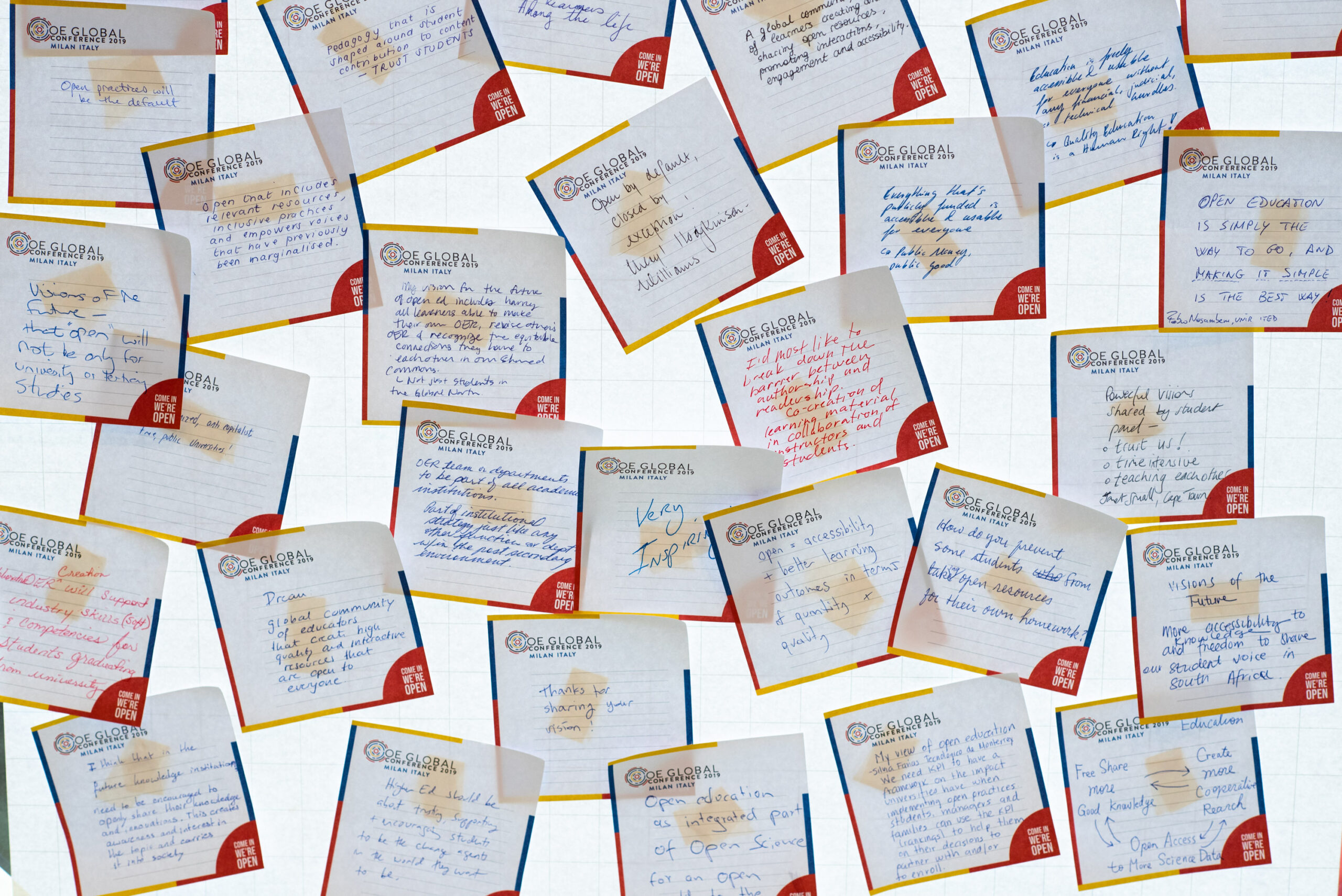
Wish to learn more about Open Education? Explore the open, ever-evolving discussion on the key concepts of Open Education in OEGlobal Connect. We’ve extracted the thoughts of Open Education leaders from 2015 as the foundation on which to build, and see just how far we have grown as a community. Feel free to add your thoughts and ideas.
- What is Open Education?
- What is OER?
- Why does OER matter
- Where do you find Open Education Courses
- What is Open Pedagogy?
- What is Open Source Software?
- The six tenets of Open Education