As part of OEGlobal’s Strategic Plan 2021-2030, it is committed to Value Co-creation – aligning with partners worldwide to build, advance, and expand the use of Open Education worldwide. With this in mind, OEGlobal continues to work with partners to develop and launch (or just support) key focuses that ensure a viable, solid, and sustainable future for open education.
OEGlobal welcomes expressions of interest around partnering and collaboration at any time. Below are the special projects OEGlobal has collaborated on over the years.
Current Value Co-Creations
Network of Open Organizations
The Network of Open Orgs is an alliance of diverse organizations and leaders dedicated to expanding global access to knowledge. Established in 2019, the Network aims to support open education efforts across the globe. Inspired by the 2019 UNESCO OER Recommendation on Open Educational Resources (OER), The Network of Open Orgs seeks to support practitioners and their national governments to enable more effective implementations of OER by catalyzing collaboration on local, regional and global Open Education initiatives that require concerted, coordinated efforts among a broad range of stakeholders. Open Education Global coordinates the network and hosts monthly meetings open to all interested parties. For more information, visit the Network of Open Orgs.
Open Education for a Better World

OEGlobal has been actively involved with the Open Education for a Better World Program (OE4BW) since January 2019. Initiated in 2018 by the UNESCO Chair on Open Technologies for Open Educational Resources (OER) and Open Education and the University of Nova Gorica, Slovenia, OE4BW is an international online free mentoring program. It supports the development and implementation of OER about topics with a social impact and addresses one or more UN Sustainable Development Goals (SDG). Igor Lesko, from OEGlobal, was involved in a hub coordinating capacity, guiding 12 projects and mentors from Africa, Europe, and Asia over 2019 and 2020.
For more information, visit Open Education for a Better World.
Previous Value Co-Creations
UNESCO OER Recommendation
OEGlobal played an active role in drafting the UNESCO Open Educational Resources (OER) Recommendation, which was unanimously adopted on 25 November 2019 by 193 UNESCO member states at the 40th UNESCO General Conference. OEGlobal views this as a unique and essential milestone that offers a significant opportunity to advance open education worldwide.
OEGlobal believed that the best way forward to ensure the successful implementation of this recommendation worldwide was to join forces in a coalition. The benefits of a coalition were seen as:
- Showing, through action, how organizations supporting open education around the world can work together.
- Ensuring that each organizations does not duplicate efforts or offer separate, competing, redundant support.
- Distributing efforts to develop and deliver robust, comprehensive support in a way that leverages our respective strengths and expertise.
- Ensuring that resources and services aimed at supporting the recommendation are high-quality, comprehensive, and consistent across our organizations.
- Making it easier for our members and constituent stakeholders to clearly know who to approach and what they will receive to ensure separate and non-conflicting support is offered.
- Signalling to governments, funders, and the global open education community that our organizations are working in a coordinated way to support the recommendation.
- Making it easier for funders to provide targeted funding by reducing potential duplications and the number of proposals they might get from each organization to do similar things.
OEGlobal reached out to a trusted network of partners with an established track record of working collaboratively. As a result of that outreach, an initial group of founding partners was formed, including (in alphabetical order):
- Commonwealth of Learning
- Creative Commons
- International Council for Open and Distance Education
- Jožef Stefan Institute
- Knowledge 4 All
- OEGlobal
- Slovenian National Commission for UNESCO
- SPARC Europe
- SPARC North America
The coalition met and collectively developed an action plan in 2020, that resulted in the Network of Open Organisations (see above). The focus of the alliance was on implementation support for the Recommendation’s five areas of action:
- Building capacity in stakeholders to create, access, use, adapt and redistribute OER.
- Developing a supportive policy.
- Encouraging inclusive and equitable quality OER.
- Nurturing the creation of sustainability models for OER.
- Facilitating international cooperation.
- Monitoring and reporting.
Open Education Policy Forum
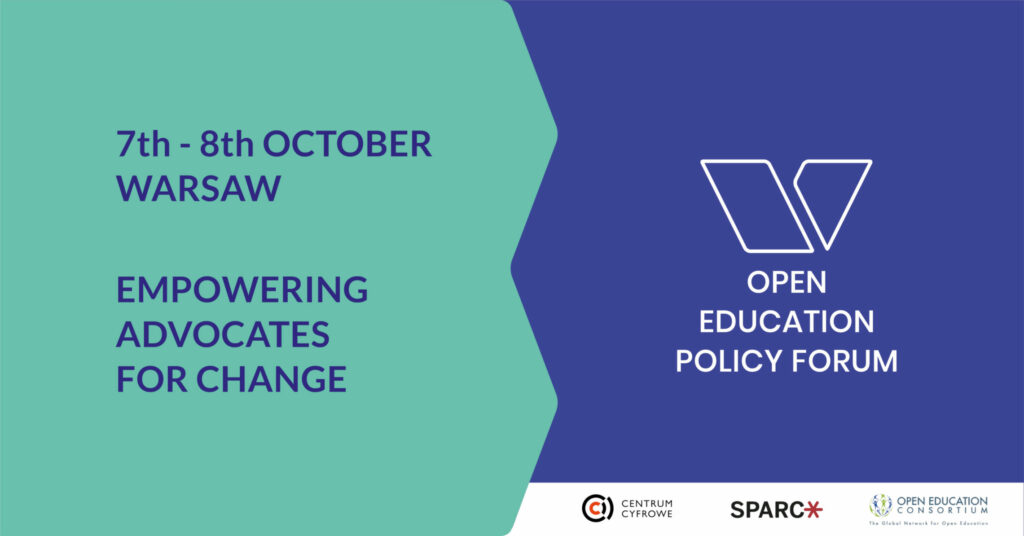
OEGlobal partnered with Centrum Cyfrowe in Warsaw, Poland, and SPARC USA to develop and host the Open Education Policy Forum. The forum’s goal was to involve participants in creating an open education policy for their institution, region, or country. Starting with a two-day workshop in Warsaw, Poland, in 2019, the participants worked on their policy, which they presented during Open Education Week in March 2020. The Open Policy Forum continued in 2020, 2021 and 2022.
For more information, visit Open Education Policy Forum.
Open EdTech
OEGlobal partnered with Moodle and other education technology organizations on a working conference for every one actively building the future of education on open technology. The event was the first of its kind and brought together open software projects, government education ministries, development organizations, academics, educational institutions, and users to work towards building a solid open-source technical infrastructure to support education in the decades ahead. The inaugural Open EdTech Global took place in Barcelona in 2019. It resulted in 12 guiding principles and working areas, described in the Barcelona Open EdTech Global Blueprint.
For more information, visit Open EdTech Global.