


This guest article is contributed by Dr Chrissi Nerantzi, Professor in Creative and Open Education, School of Education, University of Leeds, UK, one of the team that has just published the Open Textbook, Learning With AI. This is part of a new series of community articles on OEGlobal. We are excited to share the journeys, successes, and ideas of open educators from around the world.
Generative artificial intelligence (GenAI) has simultaneously created turbulence, fear and excitement amongst both students and educators within higher education and beyond. There has also been a mind-blowing explosion of publications. So much so, that it is becoming a real challenge to keep-up. Everything seems to be moving at the speed of light, whilst what we need is to slow down, think, consider, and act responsibly. Education should be driving education, not big tech and their commercial interests.
We all have many questions. Questions mean we are curious. Questions mean we want to explore. Questions mean we know that we don’t know. How can GenAI become a vehicle for equitable, inclusive, and sustainable education for all? How can the Higher Education sector play a key role in the future directions of education that big tech companies seem to simply see as a lucrative business? How can we learn with GenAI as collaborators and co-thinkers (AI Swiss, 2025)?
The recent UNESCO Digital Learning Week, “AI and the future of education: Disruptions, dilemmas and directions,” took place from September 2 to 5 this year. The event brought diverse voices and perspectives together. Possible educational futures were discussed by educators, leaders, and policy makers, some of which as captured in the accompanying publication (UNESCO, 2025).
What is missing, we have felt for some time now, are authentic stories and voices from students. A recent large-scale study at Australian universities, where thousands of students were surveyed, reveals some fascinating insights. One of them is that most students need help understanding how to use GenAI effectively (de Mello Heredia, 2025). This comes as no surprise and presents a valuable opportunity for educators. What we discovered through our project is that there is fear among students to say openly that they are using AI in their studies. Often this can be traced back to institutional rules about assessment, which have become increasingly problematic throughout our sector, but can we really blame GenAI for that?
The idea for this open book was born from the need to hear the authentic voices of students. This is not about catching students using GenAI. Those kinds of negative narratives are damaging to educator and student relationships. We are all new to GenAI. We are all learning. We need to find positive ways to embrace and engage with GenAI.
This project, and the book itself, are about learning with, and from, each other. It is about the values of openness and sharing. It is about gaining genuine insights into how students are currently using GenAI in their learning, critically and creatively. Can we learn from, and with, our students? Yes, we can!
This is what we did in this project. We were fortunate to be supported by our institution and the Leeds Open Books initiative led by the University of Leeds Libraries.
The project is student-led. Up to September 2025, the book has been edited by student ambassadors Amani Assan and Olivia Davies, with support from staff in the School of Education, Digital Education Services, the Libraries, Organisational Development and Professional Learning, Curriculum Redefined, and the Knowledge Equity Network.
The whole team is very excited, as the Learning with AI book has just been published. It is openly licensed, and freely available to anybody who would like to read it, engage with it, and repurpose it. It has also been set-up as a research project (Faculty Research Ethics Committee (FREC) for Business, Environment, Social Sciences University of Leeds, Reference 2694, 28th February 2025). This will enable us to further use the contributions as open data to study in more depth.
It has been a labour of love, and we are grateful to the generous support we received from across the University of Leeds. The project Learning with AI is student-led and supported by University of Leeds staff in the School of Education, Digital Education Service (DES), the Libraries, Organisational Development and Professional Learning, the Leeds Institute for Teaching Excellence (LITE) and the LITE Incubator for Digital and Open Education, Curriculum Redefined and the Knowledge Equity Network.
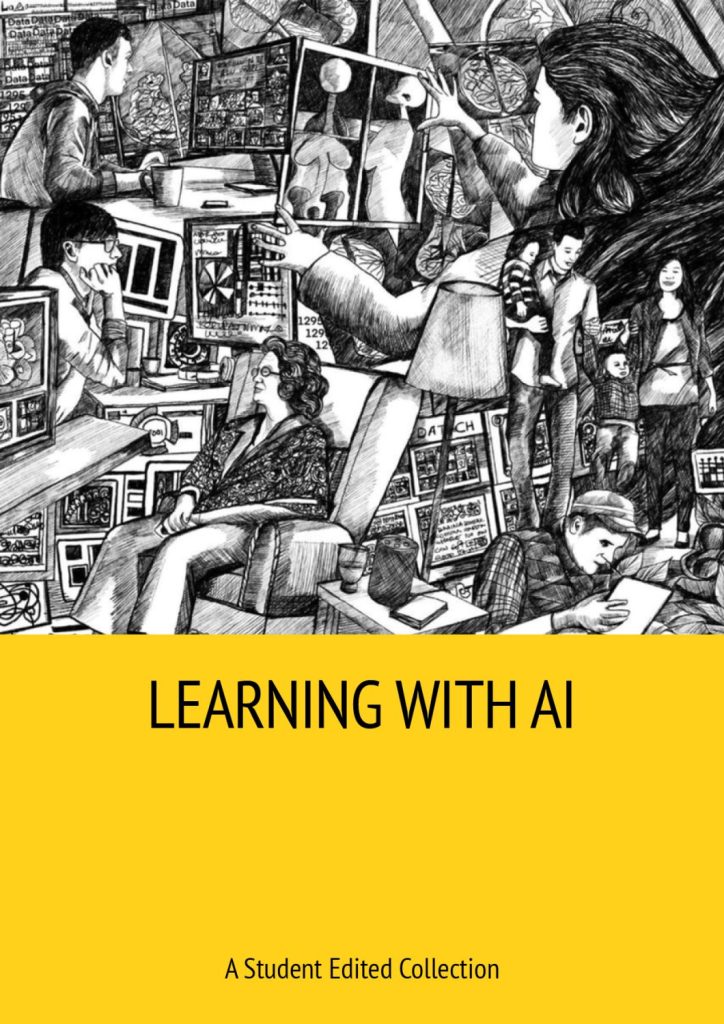
We also had a call for artwork to use for the cover. Unfortunately, the submissions we received did not meet the brief. We were fortunate to discover the Better Images of AI initiative and we decided to select the one you see on the cover.
The Learning with AI book features 28 contributions from undergraduate, postgraduate, and doctoral students from the UK and beyond. These have all been reviewed by our student editors and the whole supporting team. Contributing students are using GenAI to deepen understanding, engage in dialogic learning, and boost motivation. GenAI seems to support creativity, reflection, and accessibility, especially for diverse learners. Many value its personalised, confidence-building nature and see it as a partner in their learning journey. Ethical awareness is strong, with emphasis on responsible use and academic integrity. Together, these insights highlight AI’s transformative potential and the responsibilities it brings.
We hope that the book will become a valuable resource for students and educators alike, and help us grow the evidence-base of how we can learn critically and creatively with GenAI. Using GenAI as a tool, collaborator, and potential co-thinker and co-creator too.
The open book was developed using the Pressbook platform at the University of Leeds and is an open living book, and as such it will continue to grow and evolve. If you are a student and would like to share how you learn with GenAI, please consider submitting your story. The call will remain open until the 1st of June 2028. Your contribution will be peer reviewed and, if suitable, added to the collection.
The project is proudly sponsored by Professor Jeff Grabill, our outgoing Deputy Vice Chancellor Student Education, Dr. Margaret Korosec, Director of Digital Education and Learning Innovation, and Professor Kenny McDowal, interim Pro-Vice Chancellor Student Education and Experience.
“I think the project is going to be incredibly beneficial in illustrating the way students use GenAI to support their studies, and this work is paving the way for new educational technologies collaborating with GenAI” Amani Assan
“This project has been truly illuminating in the way it showcases the different ways students in diverse fields from global backgrounds use GenAI to assist their learning. It is a valuable resource to learn more about the different collaborations with GenAI in education currently being employed by students worldwide.” Olivia Davies
We would love to collaborate on this project with students and colleagues from other institutions. If there is interest, please reach out to the project lead.
Reference: Nerantzi, C., Davies, O., Ahsan, A., McDonald, D., McDermid K, Freeth, T., de Blacquière-Clarkson, R., Palfreyman, J., (2025) Learning with AI – by students, for students and educators.
Project team
Student editors 2024/25
- Olivia Davies, MA student, Terrorism and Insurgency, a Digital Education Student Ambassador
- Amani Ahsan, BSc student, Sustainability and Environmental Management, a Digital Education Student Ambassador
Project support team
- Dr Chrissi Nerantzi, Professor in Creative and Open Education, School of Education, University of Leeds (project lead)
- Kirstine McDermid, Open Educational Resources Manager, University of Leeds Libraries
- Thom Freeth, Producer and Relationship Manager from the Knowledge Equity Network
- Dr Damian McDonald, Senior Learning Technologist, Digital Education Service (DES)
- Dr Richard de Blacquière-Clarkson, AI Hub Lead, Organisational Development and Professional Learning
- John Palfreyman, Associate Professor in Digital Strategy, Leeds University Business School (LUBS)
References
- AI Swiss. 2025. Human-AI Co-Thinking: Transforming Swiss Education. White Paper. https://a-i.swiss/resources
- de Mello Heredia, J. 2025. Uni students are using AI to ‘ask stupid questions’ and get feedback on their work. The Conversation. 27 August 2025. https://theconversation.com/uni-students-are-using-ai-to-ask-stupid-questions-and-get-feedback-on-their-work-263535
- UNESCO 2025. AI and the future of education: disruptions, dilemmas and directions. UNESCO. https://doi.org/10.54675/KECK1261
Learn more about this project in our upcoming webinar featuring students and staff from University of Leeds, OER Under the Hood: An Open Pedagogy Approach to AI Literacy, co-produced with Pressbooks, taking place November 19, 2025.