

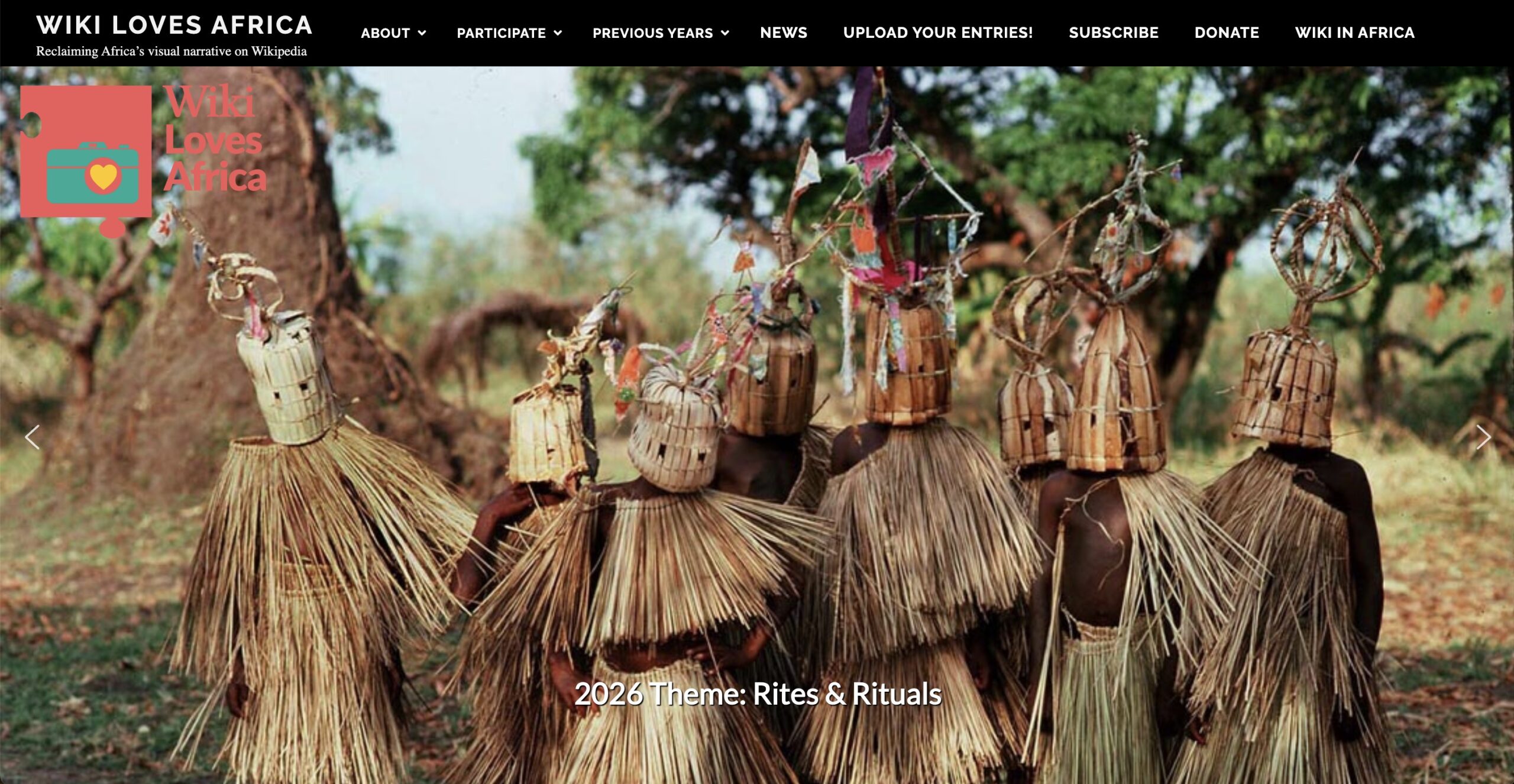
I was honoured and excited last year to be invited by my colleague Isla Haddow-Flood to be one of the judges for the Wiki Loves Africa photography contest where the theme was all about food, from Farm to Table. Wiki Loves Africa is a monumental effort that elevates the visual representation of Africa people and culture plus along the way adds a significant number of photographs to Wikimedia Commons. I can remember the winning photos well, but was also overwhelmingly impressed with the process.
It was easy to respond to the email invitation from project co-leader Hilary Ogali to be on the jury for 2026. The theme this year is fascinating and broad, Rites and Rituals:
The theme Rites and Rituals invites participants to explore the diverse ways African communities mark important life stages, honour traditions, and express their collective identity through symbolic practices. It recognises that rituals are central to cultural expression, shaping how individuals and groups connect with their past, present, and future.
The scope of the theme spans a wide variety of ritual expressions. Rites of passage, for instance, are among the most profound cultural practices. These rituals signify a person’s transition from one stage of life to another and include ceremonies such as birth and naming celebrations that welcome new life, initiation rites that mark entry into adulthood, community membership, or new responsibilities, marriage ceremonies that symbolize union and family building, and funeral rites that honor the dead, mourn loss, and reinforce cultural beliefs about life and the afterlife. Submissions in this area might capture the intimacy, symbolism, and emotion present in these milestones.
https://commons.wikimedia.org/wiki/Commons:Wiki_Loves_Africa_2026/Theme
As I understand it, for 2026 the coordinators reviewed and culled from more than 46,000 submitted entries to a set of 4300 that went to the jurors (me!) for the first round. The process makes use of the photo evaluation wikimedia tool Montage that makes the judging process one where we can focus on the photos without being burdened filling out web forms. The project managers are there always to lend support via a Telegram group.
We recently finished the first round in each each photo judge was assigned some 2000 photos. In the montage tool, we just make a yes/no determination to keep a photo in the competition, by referring to how well it shows the theme, tells a story, and has good photographic quality. It was maybe 2 hours of time to flip through and vote, and I find a certain rhythm and flow in doing them all at once.
Quite easily digital photography is my hobby and passion just for the joy of capturing detail in the world. Having some 76000 photos saved to flickr since 2004, and taking at least one photo a day (when possible) means I also have a rather detailed record where I have been and what I was doing.
But more than that, I feel strongly that being easy for anyone to make and share a photo, means it is one of the best ways to introduce people to sharing online, make use of open licenses, and also to be deliberate in using and attributing other people’s photos in resting content.
That’s why I have always very much liked the We Like Sharing annual photo competition coordinated by Bea de los Arcos at OEGlobal member TU Delft, and aligned every years since 2021 as part of Open Education Week (and its award-winning too). It’s less about the competition and more about encouraging the value and understanding of sharing under open licenses. I’ve always felt that it was a model that other organizations could easily replicate (note I am pleased tgar Bea too is on the jury for Wiki Loves Africa).
The process went by so quickly last year and I regret not sharing it more with the OEGlobal community. You can follow the process from the Wikimedia Commons pages for Wiki Loves Africa but I will add my own updates as a photo jurist in the replies to this post in OEG Connect. You can follow the insiders perspective there (but I will not reveal any photos until the winners are announced).
Over the past 11 years, Wiki Loves Africa has resulted in nearly 150,000 photos being added to Wikimedia Commons share under a CC-BY-SA licence. These images can be found on more than 37,000 pages in Wikipedia, Wikivoyage and Wikiquote. Hey someone should nominate it for some kind of award!
I hope you stay tuned for the results of Wiki Loves Africa.


Right before I wrote this post, I did complete Round 2 of the judging process in the Montage tool. In this round, I was assigned around 320 photos that are presented one at a time.
The method in this round is a 1-5 rating of how good we feel the photos are in terms of composition/quality but also for it supporting the theme. while viewing the photo, I simply type the number for my rating, it registers and displays the next one. I can say I was able to go through these in about an hour, again, once I start I find a good rhythm, and I feel more consistent in doing them all at once.
I can see the photo quality and level of interestingness rises in round 2. I’d say maybe 50% of the photos I saw in round 1, so many feel new.
Looking forward to round 3.
This week was round three, and it too was a big challenge. All the voting members of the Jury were assigned the same 73 photos and we had to drag and move them around in order from our perspective from 1 to 73rd ranking.
It was a lot of work sliding the previews up and down the page, much less making the call for the top photos. There was a good number I had seen in rounds 1 and 2, but a few that were new.
The pool of photos are really good this year.
What are your thoughts fellow jury member @bdelosarcos ?? Was this one as hard as it felt to me?
The fourth and final round of reviews is done for the jury (this particular one getting done just at the deadline) and again was a joy as a serious challenge. In this assignment, we had to pick our favorites from 29 photos that made it to the final round (it is hard not to share any details!).
In this case, we received a link to a Google Sheet to copy, with a preview and links to the finalists. We are given 100 points to allocate across at least our top three rates photos, distributing the larges number for our 1st choice (no more than 50 points), then our second (no more than 35). We had the option to add comments.
I could not reduce my votes to 3 photos, so I spread my points across 6 photos. I included comments for more than my six as there were many striking images worth noting for their composition, storytelling, and just appeal.
I understand that the Wiki in Africa Team is now working to be able to announce the winners at Wikimania 2026, July 21-25 in Paris, stay tuned there for the big announcement.