
This article is part of Come Invent With Us: Perspectives On OEGlobal 2026, a series of viewpoints on OEGlobal 2026’s program tracks by the Open Education practitioners who make up the OEGlobal26 Host Organizations.
In this piece, Dr. Kisha G. Tracy, Professor and Chair of English Studies at Fitchburg State University and co-chair of the Massachusetts Open & Low Cost Educational Resources Advisory Council (OLERAC) — one of OEGlobal 2026’s three co-hosting organizations — draws on her own story of unlearning to ask a pointed question: what does it truly mean to democratize knowledge through Open Education, and is “open” alone enough to get us there?
__________________________
I grew up in a small town in southern Illinois. There were no persons of color living in my entire county until after I graduated from high school in 1998 when the first Black family moved in. That same year, as I prepared to go to college, a cross was burned in front of this family’s furniture store. Also, while I am positive there were individuals with a wide range of gender identities around me while I was growing up, they did not feel comfortable or perhaps even safe disclosing them publicly in that time and space. This is a background that I often share with my students.
Although I have always tried to be “open-minded” and “tolerant,” especially as I was raised in an educated family of teachers, it took many years of unlearning to begin to recognize what I had internalized by growing up in this environment. Now, many years later, I still have much to do, as, I believe, do we all. It’s a constant work in progress.
As a teacher, this reflection and rethinking led me to universal design, open pedagogy, and Open Educational Resources (OER). One of the purposes of OER is to break down barriers to access, addressing issues of economic privilege, in particular.
But we sometimes rely a bit too heavily on the “open” to do the majority of the work in “Open Education.” If it is freely available, then the goal is met. There is more to democratizing knowledge, however, than just access. OER is an opportunity to redress marginalization and erasure, and open pedagogy has a responsibility to confront social justice issues. Sarah R. Lambert (2018, p. 239 with definitions from p. 227)[1] created a social justice-focused definition of Open Education as “the development of free digitally enabled learning materials and experiences primarily by and for the benefit and empowerment of non-privileged learners who may be under-represented in education systems or marginalised in their global context. Success of social justice aligned programs can be measured…by the extent to which they enact redistributive justice [allocation of material or human resources towards those who by circumstance have less], recognitive justice [recognition and respect for cultural and gender difference] and/or representational justice [equitable representation and political voice].” In addition to providing or redistributing access, OER should both be aware of recognizing the under-represented and then amplifying their voices.
When I created the open access textbook Why Do I Have to Take This Course? A Guide to General Education[2], published through the Remixing Open Textbooks through an Equity Lens project, I wanted to help students think about why they take General Education courses and what the significance of that type of learning is. When I began the project, I started by considering my intended audience. I particularly am interested that first-generation students and other marginalized communities have access to the tools and information they need to navigate higher education, which might include background on what a liberal arts education is, who makes decisions about their curriculums, and the reasoning behind those decisions.
I chose to frame the discussions through the lens of U.S. Representative and Civil Rights activist John Lewis’ philosophy of “good trouble, necessary trouble,” emphasizing how general education provides a basis of knowledge and skills for creating social change, selecting examples that represent a range of experiences and identities. I wanted to include a variety of diverse voices through quotations by students, alums, faculty, staff, and community members. In these ways, I feel I have worked towards Lambert’s call for OER to demonstrate redistributive, recognitive, and representational justice. Yet, of course, I know that my textbook is far from perfect, that there is more work to do.
This is where collaborating and inventing with others – such as at OEGlobal 2026 – can be invaluable. It is not only the product that should be open, but the process itself as we help each other learn, point out internalized assumptions and biases, and broaden our scope of understanding and empathy – all of which can be both fulfilling yet humbling experiences. Our students not only deserve to have access to equitable and inclusive knowledge, they deserve to have the systems that influence that knowledge embody those beliefs as well.
__________________________
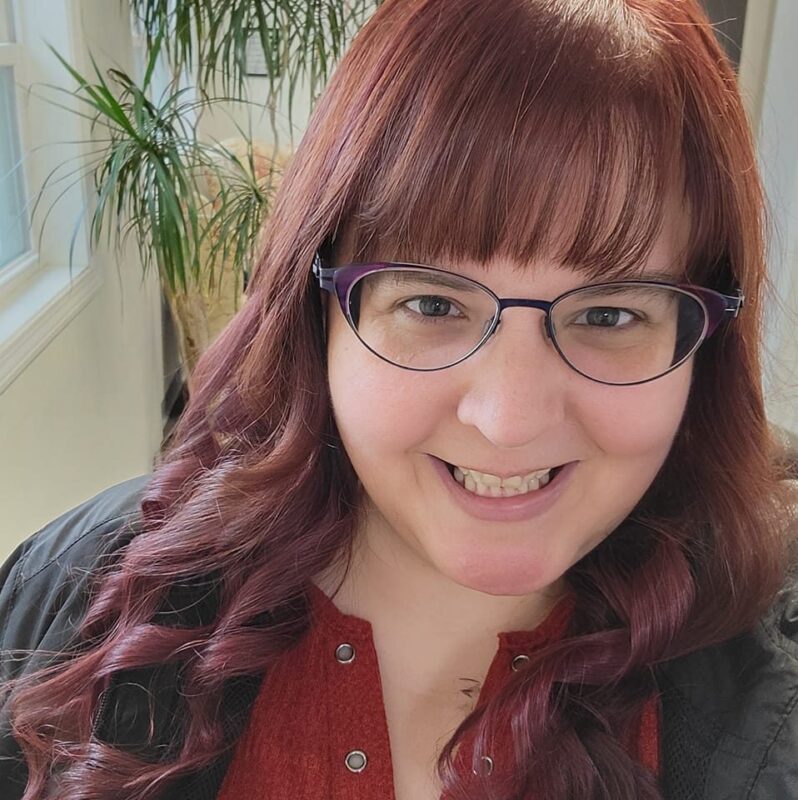
Dr. Kisha G. Tracy is a Professor and Chair of English Studies and former Chair of the General Education Program at Fitchburg State University. She received her Ph.D. in Medieval Studies from the University of Connecticut. In addition to several articles, her first book, Memory and Confession in Middle English Literature, was published by Palgrave in 2017, and her second book, Why Study the Middle Ages?, was published in 2022 by Arc Humanities Press.
Her research interests include medieval disability, especially mental health, and the scholarship of teaching and learning. She has created two OER textbooks entitled Why Do I Have to Take This Course? A Guide to General Education and Heritages of Change: Curatorial Activism and First-Year Writing (grant-funded by Remixing Open Textbooks Through an Equity Lens), and both were short-listed for the OE Global Education Awards for Excellence. She serves as co-chair of the Massachusetts Open & Low Cost Educational Resources Advisory Council (OLERAC) and on the Fitchburg State Open and Affordable Education Committee. She was awarded the Massachusetts Dept of Higher Education OER 2024 Gold Faculty Award.
She is a member of the OEGlobal26 Steering Committee.
__________________________
OEGlobal 2026 — Come Invent With Us! takes place October 7–9, 2026, at MIT’s Samberg Conference Center in Cambridge, Massachusetts, in a hybrid format open to participants worldwide. The conference is co-hosted by Open Education Global (OEGlobal), MIT Open Learning, and the Massachusetts Open & Low-Cost Educational Resources Advisory Council (OLERAC), and marks the 25th anniversary of MIT OpenCourseWare. Learn more and register at conference.oeglobal.org.
[1] LAMBERT, S. R. (2018). Changing our (Dis)Course: A Distinctive Social Justice Aligned Definition of Open Education. Journal of Learning for Development, 5(3). 225-244. https://doi.org/10.56059/jl4d.v5i3.290.
[2] TRACY, K. G. (2024). Why Do I Have to Take This Course? Remixing Open Textbooks through an Equity Lens. https://rotel.pressbooks.pub/whydoihavetotakethiscourse/.


This new article in the conference series starts with Kisha Tracy sharing her own “unlearnings” towards a social justice perspective as an open educator. Perhaps consider sharing your own unlearnings or just what are the ways we can join her in going beyond resources and access to her ideal: